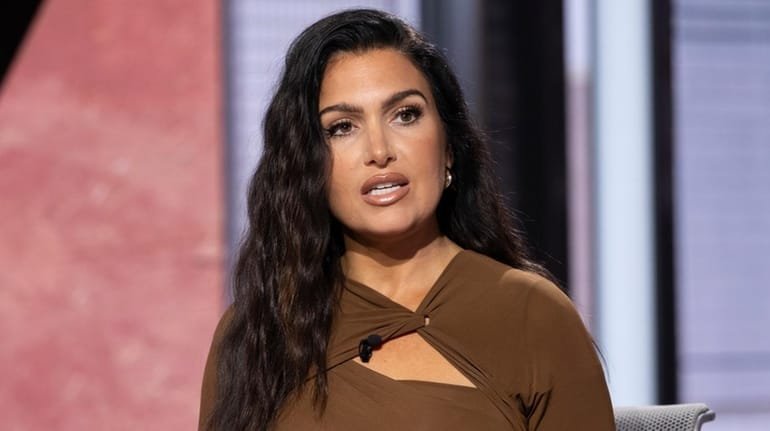
After nearly a decade as the face of ESPN’s First Take, Molly Qerim announced her departure in September 2025. Her Instagram post was gracious and reflective — but the story behind it was considerably messier.
What actually happened involves a rejected contract offer, a planned demotion, and a calculated decision about how to leave on her own terms. Understanding the full picture requires separating what is confirmed from what is commentary — and looking at the business logic that drove the whole situation.
Who Molly Qerim Was to First Take’s Business Model
Qerim joined First Take as moderator in 2015 and held the role for roughly ten years. To casual viewers, her job might have looked simple — ask questions, keep things moving. In practice, she was the structural center of the show.
First Take is built around strong, often clashing personalities. Stephen A. Smith brings volume and opinion. Rotating analysts bring different perspectives. Someone has to manage the pace, keep segments on time, and maintain the kind of consistency that makes a show work for advertisers. That was Qerim’s function.
First Take is frequently described as the number-one show in sports media. That makes its moderator role far more valuable than it might appear from the outside. Losing someone in that seat after ten years is not a minor personnel change — it carries real business weight.
What Actually Happened — The Confirmed Facts
In September 2025, Qerim posted on Instagram that she had decided to “close this incredible chapter and step away from First Take,” calling it “one of the greatest honors” of her career. The language was warm and controlled.
The reporting told a different story. According to Sports Business Journal, Qerim rejected ESPN’s contract renewal offer and would leave at the end of 2025. ESPN content executive Burke Magnus confirmed publicly that the network had already decided she would be removed from First Take when her contract expired.
Stephen A. Smith addressed the departure publicly as well. He said she left voluntarily and had “issues that I’m not going to discuss — it wasn’t with me.” He also noted that ESPN did not want to lose her and that contract negotiations were still ongoing when she made her decision. She was ultimately replaced by Shae Cornette.
To be precise about the record: Qerim was not fired in any traditional sense. What happened was a combination of a contract disagreement and a planned role change — both of which collided in a way that made staying impractical.
The Contract Gap and the “Slap in the Face” Framing
Reports from people familiar with the negotiations indicate that ESPN and Qerim were significantly far apart on contract terms — not a minor difference in numbers. One former ESPN figure, cited by Sports Illustrated, described her reaction to the offer as viewing it as a “slap in the face.” That characterization is worth using carefully — it reflects one person’s interpretation of her response, not a direct quote from Qerim herself.
But the framing makes sense when you factor in the context. Burke Magnus had already signaled that she would be moved off First Take when her contract ended. That means any new offer came attached to a demotion in visibility and status. In that situation, the dollar figure almost becomes secondary.
Think of it this way: if a senior executive is told they will be moved to a less prominent role at renewal time, and then receives a lower salary offer to match, the offer isn’t just about money. It’s a signal about where the company places their value. That tends to land harder than the numbers alone.
In media business terms, an on-air personality’s leverage is tied directly to their platform. Accepting a reduced role at reduced pay, after ten years of anchoring a flagship show, communicates something specific — to future employers, to the industry, and to the talent themselves. Many people in that position would reach the same conclusion Qerim apparently did.
The Lame Duck Problem in Broadcast Television
Chris Russo offered one of the more useful frameworks for understanding why Qerim left when she did, rather than staying through her planned removal. His theory: she left early specifically to avoid being seen as a lame duck host.
Once it became known — or once it was going to become known — that ESPN planned to remove her from First Take at contract’s end, her position on the show would shift. Viewers, colleagues, guests, and potential future employers would all be watching someone who was publicly on the way out. That changes the dynamic of every appearance.
The lame duck problem is not unique to television. In politics, leaders who announce they won’t seek re-election often find their influence fades immediately, even though they still hold the office. The same logic applies in media. When an audience knows a host is leaving, they start thinking about the replacement. The host’s authority erodes in real time.
Leaving before that perception fully set in — framing the exit as a personal decision rather than a managed removal — gave Qerim at least some control over her own narrative. Reports suggest the news came out earlier than she intended, which complicated that effort. But departing on her own timeline was still preferable to being the person everyone knew was being shown out.
There is also a practical career argument here. A host who leaves a major show voluntarily, and frames it as a chapter closing, enters the job market differently than one who is visibly wound down while still on air. Future networks and producers notice the distinction.
What This Reveals About Talent Management in Sports Media
Qerim’s departure is a useful case study in how contract negotiations can go wrong — not through any single dramatic event, but through a series of signals that accumulate into an exit.
ESPN communicated, through Burke Magnus, that Qerim’s time on First Take was ending regardless. That single fact changed the entire negotiation. She was no longer bargaining from the position of someone the network needed to keep happy on its most valuable show. She was bargaining for a consolation arrangement — and the offer reportedly reflected that.
At the same time, ESPN faces a real business challenge with long-running talent. A moderator who has been central to a show for a decade becomes expensive to retain and difficult to move. Networks often manage this by gradually repositioning talent, introducing new voices, and adjusting contracts at renewal. The process can look clean from the outside. When it doesn’t work, situations like this one emerge.
For anyone tracking how major media companies manage on-air talent, this situation fits a recognizable pattern. The host’s leverage depends on the network’s need. When the network signals it is ready to move on, the talent’s options narrow quickly. The question becomes not whether to leave, but when and how.
Resources like Nextbiztips often cover dynamics like these — where business decisions and public-facing roles intersect in ways that are rarely as clean as the official statements suggest.
Where Things Stand Now
Shae Cornette has taken over as moderator on First Take. Qerim has kept a relatively low public profile since her departure, with limited appearances and no confirmed next role announced at the time of writing.
Whether she returns to a major network, launches something independently, or steps back from sports media entirely remains an open question. What is clear is that she left one of the most visible moderating roles in American sports television — and that the circumstances behind her exit were shaped more by business dynamics than by any personal falling-out.
The story of Molly Qerim leaving First Take is ultimately a story about what happens when a network’s plans for a show diverge from a talent’s expectations for their career. The contract was the flashpoint. But the real issue was the signal that came before the offer was even made.
In sports media, as in most industries, how a company treats a negotiation tells you more than the final number does. And sometimes, the most strategic move is simply to walk out the door before someone holds it open for you.
Read Also: